Showing posts with label Elliott. Show all posts

24 Feb 2010 | | 0 comments

Final Cut Pro

Final Cut Pro is a program that helped our editing process greatly. From a student who had to edit our thriller film last year, I can say that FCP is far more superior in terms of features and accessibility than what I used last year, Apple iMovie. 


One of the main features that helped us during the editing process, was the ease of which overlapping, fading and manipulating was done at. As learnt from this website during the research process, a fade in is "a quiet introduction to a scene". This introduction of tranquility was something we wished to capture, and the ease of which it was available with FCP was very helpful.


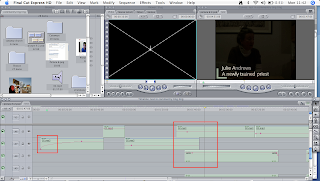
As we had to overlap music and in scene audio quite a bit, it was useful that FCP was able to do it easily. As you can see in the screenshot, dragging and dropping is the extent to overlapping audio and it was a very helpful feature. I remember trying to accomplish this last year using iMovie, however it being a much longer task - this is because FCP supports many more 'tracks', so various layers of audio and video can be added with ease. 

FCP manages video footage in an efficient way that made keeping track of video easy. As you can see in the screenshot, 'bins' where created which held our footage. We could for example, (and did), create a folder called 'Cutaways' and in here store all relevant footage. All in all it made editing a much quicker process.


FCP allowed us to use a range of video transitions, far more than iMovie, and have greater control over them. We could for example control the transitions' size, time, and even movement. As shown in the screenshot, a sequence of Fade in/out shots give the effect of time passing. FCP made it easy to achieve this, with a simple drag and drop before each shot giving a fade in and out effect.
Addition of text or titles was simple. FCP allowed us to modify the size of the text, where it was placed, and font face. As you can see here, Sharon's name is placed in the bottom left hand of the screen. This is a typical convention of documentaries, and is often used when introducing an interviewee. This was inspired by various documentaries as the majority of documentaries include this technique.
An example of the convention being used.

22 Feb 2010 | | 0 comments

How each ancillary text will appeal to the target audience?

How each ancillary text will appeal to the target audience?
Where will the text appear?
Why are these formats appropriate?

 
Radio:

From our research on radio adverts, we found out that our advert would fit most appropriately on the BBC radio station, Radio 4. Why we chose this is because of findings from the BBC wikipedia page:
  • Radio 1 ("the best new music and entertainment")
  • Radio 2 (the UK's most listened to radio station, with 12.9 million weekly listeners)
  • Radio 3 (classical and jazz music)
  • Radio 4 (current affairs, factual, drama and comedy)
  • Radio 5 Live (24 hour news, sports and talk) 
From here, it was clear Radio 4 was the station that most related to our program.

The fact we chose Radio 4 sets out the target audience to an extent, as it already appeals to a quite defined audience. On researching the Radio 4 demographic audience, I found the following, defined in its service license:

"The remit of Radio 4 is to be a mixed speech service, offering in-depth news and current affairs and a wide range of other speech output including drama, readings, comedy and factual and magazine 
programmes. The service should appeal to listeners seeking intelligent programmes in many genres which inform and educate and entertain"

The text highlighted in bold defines why we chose Radio 4, as each relates to our advert. 


As the issue of Christian homosexuality has become such a widespread topic, yet still appears in headlines regularly, shows that it is still part of current affairs. It is an issue yet to be resolved - this week for example, a headline has been: Government should not stand in way of homosexuals marrying in church, say Tories


Our documentary contains no re-enactments, and documents purely factual knowledge. 


Additionally, everything from language used, to the very core subject of our documentary is something that would appeal to people seeking intelligent programmes. Our documentary idea falls under two main categories, religious and current affairs. Both these are ideas which relate predominantly if not exclusively to that of an intelligent audience.

In terms of timing, research of the Radio 4 schedule page showed us most religious programming is done at 16:00 - 17:00, in which ours will be best suited too.

Documentary:

As our documentary will be screened on a BBC channel, again I searched for the guidelines for this channel. It brought me to the "BBC Commisioning Documentaries" page, which said the documentary should, "challenge the audience to broaden their horizons or see their world from different perspectives". Our issue, is something which requires a mature audience to suspend their views for a few moments and see the views of others, so to create their own. For an audience to do this, it requires a level of maturity that resides in a mature age group. The subject is so broad, and relates to so many people in different age groups. It would be inefficient to target it at a age group exclusively. Therefore, the target age audience is mature persons, generally over the age of about 16.
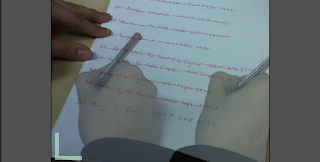
The documentary commision page says the ideal documentary should "make more traditional docs subjects modern and relevant". As all young documentary makers, we made it from the viewpoint of someone with a modern point of view, with new ideas. This is evident from the hybrid style of documentary we used, in which we combined traditional forms of documentary into one of our own. The following image with Alex's hand, is an example of a transition that we used. It gives it a more modern feel, and is an example of something that isn't a traditional documentary convention, but something that we uniquely used - again re-affirming the BBC as the best network to screen our documentary.
8 Feb 2010 | | 0 comments

What media texts did you look at to research your ancillary text?

What media texts did you look at to research your ancillary text?

Throughout, we used a variety of media texts to research the documentary genre, become clear of its conventions, and influence our individual shots. 


Firstly comes the research done for documentary's in general. As an avid 'Louis Theroux' documentary viewer, much influence and initial ideas came from his style. His unique way of presenting the documentary almost like a journey of education, on a subject that is both new to him and the audience is something we took influence from (we too where working on a subject new to us). This is evident in our use of camera shots - for example, the train journey sequence connotes the process as being a journey, not just literally, but also a journey of discovery for both us and the viewer. Secondly, our voice over used describing the problems occurred creates a link between the viewer and documentary maker which in effect establishes an intimacy, reminiscent of Louis Theroux's style of talking directly to the viewers. 


The following interview I watched before planning, provided research into exactly how Louis goes about planning, and creating his documentary ideas - it was very helpful.


Louis Theroux makes the statement I’m not a journalist, I’m a friend” and even though we didn't take this as far as Louis Theroux does, we did make sure to incorporate it partly. In the first interview with Julie the newly trained priest, I invited her to my house and had a near one hour chat beforehand, which created a greater understanding of each other and made us both feel more comfortable in the interview.


In terms of documentary films, as a class we visited The Ritzy and saw the documentary 'Starsuckers'. Although the subject matter differed greatly to ours, it proved a useful resource for something we can take influence from in terms of editing, camera angles and interview techniques. We also had a Q&A session with a representative after the screening. I asked a number of questions, however the question I wanted answered most ("Did you receive permission to use the television clips or not?") was not answered as the documentary maker himself could not show up. It would have been helpful to know the limits surrounding clips used, or if he knew of any reliable resources in terms of free to use clips we too could use.


For our radio advert, we first started by checking the listings of Radio 4 from this page. Once we had an idea of the times religious programming came on, mostly around 16:00 - 17:00 we could revolve our advert around this time slot, target audience and style. A few conventions where evident from listening: 
  • The adverts typically began with a music fade in with a narrative describing a problem/issue
  • Next it had someone who represented the problem/issue speaking about it
  • An opposing view or someone else who represents the problem/issue speaking was next
  • The narrator then comes in again to round it up and tell the time and date will it be shown
We followed this convention in the making of our advert. Although we changed some, we kept to our researched conventions quite a lot, most notably in narration, music and documentary audio inserts.

25 Jan 2010 | | 0 comments

First Draft of Evaluation

For our opening we went out onto the street and asked pedestrians for their opinions on our chosen subject. We put this a the very beginning of our documentary to introduce the idea using people from our target audience - everyday people. Because it was filmed outside, next to a road, there is a lot of ambient noises such as cars, which makes it harder to hear what the people are saying. Although this adds to the naturalistic feel, if we did this part again we would have chosen a quieter surrounding.


After looking at Louis Theroux's style of documentary making, we decided to create ours in the style of taking a journey of discovery. We filmed a few establishing shots such as our time on the tube to illustrate when we went to interview Sharon Ferguson. The shot of Elliott and Alex walking towards the camera introduces the idea of the interviewers being part of the learning experience. An establishing shot of Oxford House is the last of our journey filming which allows for a smooth and simplisitic transition into Sharon's interview.


While the setting of Sharon's interview looks like an office, it is actually the headquarters of the Lesbian and Gay Christian Movement. It contained lots of leaflets and pictures in relation to her cause, which meant we had some relevant cutaways by filming around the room. Its unfortunate that the monitor of her computer is on in the background as it is slightly distracting. We kept to the rule of thirds by placing Sharon slightly to the right of the frame and asked her to answer our questions looking to the left.


To introduce our second interview we used a slow low-angle panning shot to film a church which is obviously relevant to our subject. We had Julie's voice over the shot before seeing her to connect what she was talking about with the church.


During Julie's interview we had a quick succession of cutaways that we researched on the internet to quickly illustrate her points. There is also a screenshot of what she is talking about to support her speech and show that it is a widely talked about issue.


For the interview with Julie we placed her to the left of the frame and asked her to speak looking towards the right again to keep to the rule of thirds.


We had a lot of trouble choosing music for our documentary, but eventually decided to use a neutral melody that is simple and calming - keeping with the mood of our documentary.


We cut between the two interviews because they are answering the same question and so we juxtaposed their answers for contrast. During the interviews we zoomed in on Sharon's face to amplify her emotions towards what she is talking about.


At the end of our documentary we justified our lack of an opposing view. We used an over-the-shoulder shot of Alex and then a zoom into the computer to show our research into churches. The voiceover makes it clear to the audience what we are trying to get across and this is emphasised by Alex crossing out church names and numbers, all being numbers we had previously tried and failed to interview. We used an extreme close-up for this part so that the audience can read what is written on the paper and a cross-dissolve transition to illustrate time passing. The end is in slow motion because it properly portrays our disappointment which is a feature taken from other documentaries that we have looked at. We used a fade out t the very end to give an unfinished 'end of part one' feel.

9 Nov 2009 | | 0 comments

Things left to do

As we have completed 2/3 of our main interviews, all that is left is for us to complete our final interview, and some additional cutaways. On the 12th we are going to go to Streatham High Street and record a series of everyday people's individual opinions on homosexual Christians.


Our final interview will be with someone who is anti homosexual Christians, so we can therefore present a more balanced set of opinions and document both sides of the argument (which our individual research has shown a good documentary should).


4 Nov 2009 | | 0 comments

Our pitch

For our final pitch we created a detailed power point presentation that contained bullet points and visuals to help make it interesting. We had notes that we either read from or had memorised so that we were not reading straight from the power point which would have been dull.


We got positive feedback supporting our documentary, which has encouraged us further that our documentary can be a success with additional teamwork and good planning.

| | 0 comments

Rev Sharon Ferguson - Additional information

After interviewing Sharon, I asked if she would had any additional information we could use in our documentary.


She gave each of us an official LGCM small leaflet, and a booklet created by her which contains very useful information. In terms of our documentary, we can scan and use pages of the leaflet/booklet as cutaway shots which will be insightful for the viewer - and relevant at the same time.


Additionally, she said we could use her appearance on 'The Big Question' freely, which is extremely informative and embedded here:


| | 0 comments

Music for our documentary


The problem with music for our documentary is that it needs to be relevant to the documentary topic, Christianity. On the websites that Miss Taylor had given us that offer copywrite free music, there where no Christian songs.


There are plenty of Christian rock, soul, rap, and jazz bands I have found on the internet, but all hold the common problem of copyright. It was when I found this website that our problem was solved.


4praise.com offers "the largest collection of free christian music on the web", and most importantly every single song is "offered freely with full permission from the copyright holders."


We couldnt of asked for a more perfect site. I will now begin looking through the music and seeing which is most suited for our documentary.


Hallelujah!

| | 0 comments

Today’s technological problems in school

DSC00144.JPG.jpg


Today we encountered a number of problems while trying to upload our newly recorded footage onto the media suite computers. With our previous interview, we had already uploaded the footage, however not checked it. While checking today I realised that there was a sync problem with the audio and footage, which caused a number of problems. I googled for a solution and found a number of different ones. We tried each, however it merely created additional problems, like saying the "scratch disk is full". It was frustrating as not only did it mean our original footage had to now be re-uploaded, but our new footage also.

On the plus side, when filming our newest interview (yesterday) we briefly debated weather or not to film over our first interview as we already had it on the computer. It was lucky we chose not to, as if we did the film would now be lost - or at least corrupted to an extent. This has taught us always to keep original footage, as we are never aware of future problems which may arise.

We are currently waiting upon a solution from Miss Taylor, in hope that we can continue to use the iMac computers.


| | 0 comments

The Questions

In our interview with Sharon and with our interview with Julie we asked similar questions so as to provide two points of view on the same thing. The list of questions below are the ones that we directed at Sharon during her interview:

  1. I know you’re a trained reverend, what exactly where the teachings on homosexuality that you received during this training.
  2. Did these teachings differ with any teaching you had previously?
  3. Do you think that modern Christianity should adapt to modern society’s norms? (Up until 1980’s seen as mental illness but now society has adapted)
  4. Do you know quotes that in your view present directly the bibles teaching on homosexuality? Or would you say it’s for a Christian themself to decide.
  5. Homosexual conversion therapy is something which has been used more widely in the US than in the UK at the moment, but what is your view on this practice? Some have criticised it as a form of brainwashing.
  6. What are your thoughts on church members blessing a civil partnership when there is so much divide on the matter. Is it responsible for a church member to perform a service that another church might totally disagree with?
  7. Homosexuality is obviously something which has been around as long as heterosexual relationships. Homosexuals would have been punished for their acts at the time of Jesus. Why wouldn’t Jesus just condemn or condone it?
  8. I read that you are in a relationship with another woman, what different reactions have you had to this from different Church members?
  9. Because of this, God gave them over to shameful lusts. Even their women exchanged natural relations for unnatural ones. In the same way the men also abandoned natural relations with women and were inflamed with lust for one another. Men committed indecent acts with other men, and received in themselves the due penalty for their perversion” - Romans 1:26-2 - What is your view on this quote?


| | 0 comments

Our Second Interview

On Tuesday after school the whole group went along to Bethnal Green in East London by tube to a place called Oxford House. Once there we were greeted by a woman called Sharon Ferguson, a lesbian reverand, who is in her own words "the face of Gay and Lesbian Christians". More importantly, she is a representative of the 'Lesbian and Gay Christian Movement', which has been established for over 30 years. We interviewed Sharon in her office because she was surrounded by artefacts proclaiming her strong religious beliefs.

  • We asked her nine set questions that she answered in full with lots of examples and explanations which will make it easy for the viewers of our documentary to understand. 
  • We made sure to keep to the rule of thirds by placing Sharon to the right of the frame as her eyes were directed towards the left (where Alex was sat asking the questions, but out of the actual shot). 
  • Elliott was the acting camera man and he made sure to zoom in on Sharon's face when she came to an important point to make the shot more intense and personal.
  • Unfortunately during the interview our camera ran out of battery and we had to stop to charge it for a while. Luckily Sharon was very nice about it and we had a break for about ten minutes while it charged. 
  • While the camera was charging Sharon gave us some reading material on the Lesbian and Gay Christian Movement that we could perhaps use in our documentary somehow, either quoting it or filming pages from a magazine we received. 
  • We filmed her surrounding office once the interview was over to use for cut-aways and such.

20 Oct 2009 | | 0 comments

Audience Research

We created a questionnaire to find out information regarding our audience. The questionnaire contained 6 questions about their television preferences and views on homosexuality in the church. 


We put these questionnaires into graphical form to make it easier to read and draw conclusions from.


Note: Please click to make larger! They stretch the page if embedded in their original size. 


Not all the results are posted, however from the graphs shown we can determine that there is an interest in our documentary type and the subject matter.